JIAWEN Wraps Up a Successful 140th Canton Fair in Guangzhou


Specifying shower hinges looks simple until a door starts to sag, leak or fail to close. Most problems trace back to three decisions made at the quotation stage: glass thickness, mounting type and hinge function. This short guide covers what to check before ordering.
Shower hinges are rated for a specific glass range. A hinge designed for 8 mm glass should not be used on 10 mm panels — the gasket depth and clamping force are different, and the door weight will exceed the design load. Check the glass specification before choosing a model, and remember that a 10 mm door weighs roughly 25 kg per square metre.
Glass-to-wall hinges fix the door to a structural wall and carry the full weight of the panel. Glass-to-glass hinges connect the door to a fixed side panel and are common in corner or return enclosures. Many installations use a combination — two wall hinges at top and bottom, plus a glass-to-glass hinge in the middle — to share the load.
Standard models are 90° and 135°. Confirm the opening angle against the enclosure layout, and order all hardware in the same finish from the same production batch — polished, satin, matte black and gold are visually different enough that mismatched batches show up under bathroom lighting.
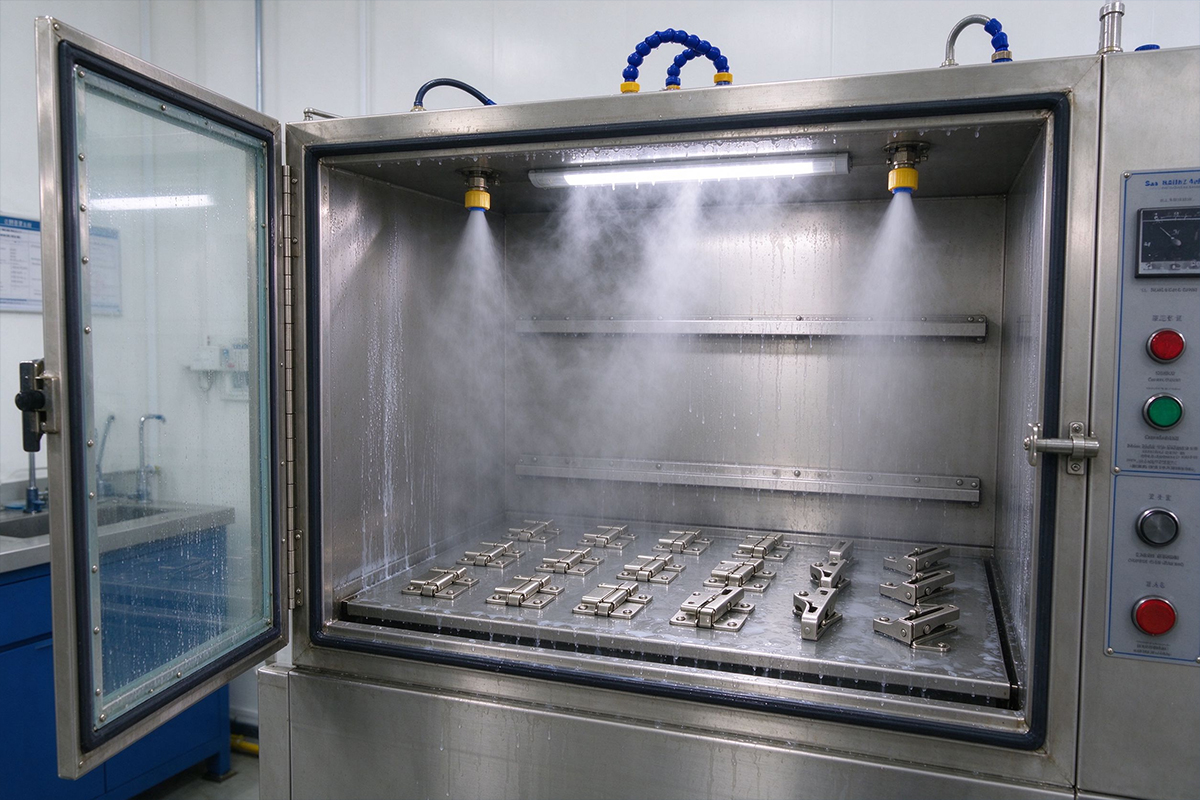
Ask for the rated glass thickness, maximum door weight and salt spray result. A hinge that fails at 200 hours will not survive a humid bathroom for five years.
JIAWEN's shower hinge range covers glass-to-wall and glass-to-glass models for 6–12 mm glass, in SUS304 and SUS316, with self-closing and self-rising options. Technical drawings and samples are available on request.